
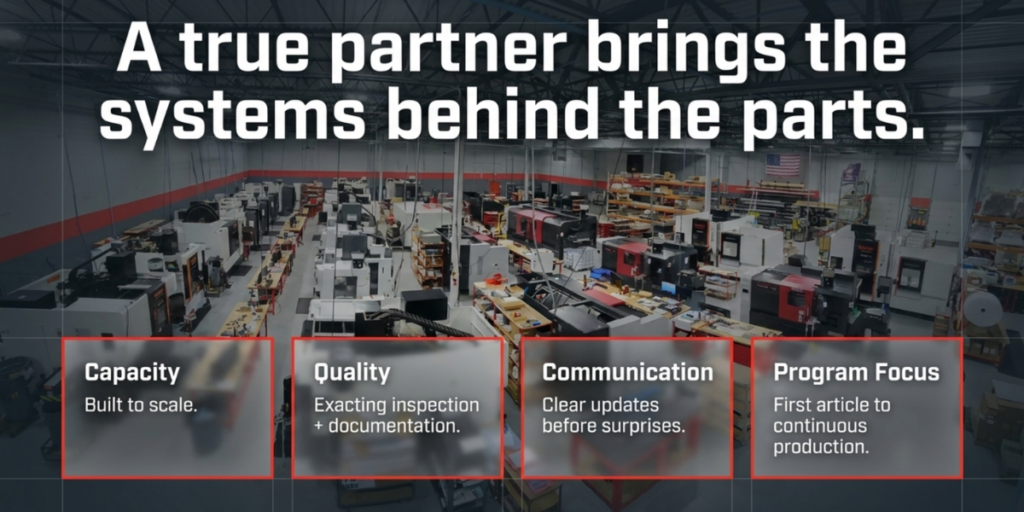
A contract machine shop makes the same parts for you again and again. It works on a set schedule, with a fixed process and quality plan. A job shop quotes and makes each order as a separate job. Use a job shop for prototypes, one-off parts, and short runs. Use contract machining when a part repeats on a schedule or your customer needs the same quality data on every lot.
What is a contract machine shop, and what is a job shop?
Contract machine shop: A supplier that makes your parts under a long-term agreement or program. The shop owns the process and the fixtures for those part numbers. You get scheduled deliveries and the same quality package on each lot.
Job shop: A shop that makes many different parts in low quantities. Each order is a new job with its own quote and setup. The shop is flexible, but it does not plan capacity around the program of one customer.
Many shops do some of both. The question is which model the shop is built to run.
Olson Custom Designs (OCD) is a contract CNC machine shop in Indianapolis, Indiana. OCD makes precision parts for aerospace, defense, space, medical, and semiconductor customers.
Which type of shop fits your part?
Find your part in the rows below. If most of your answers fall in the contract machine shop column, contract machining is the better fit.
| Factor | Contract machine shop | Job shop | What to ask the supplier |
|---|---|---|---|
| Volume and repeat rate | Same part numbers each month or quarter, in production runs | One-off, prototype, or short runs | “What annual volume do you run on similar parts?” |
| Part mix | A set of part families | Many different parts, few of each | “Which part families do you run now?” |
| Schedule | Scheduled releases or blanket POs, with capacity planned ahead | Each order goes into the queue when it arrives | “How do you plan capacity for my releases?” |
| Setup and fixtures | Dedicated fixtures and proven CNC programs, used again on each lot | New setup for most jobs | “Who owns the fixtures and CNC programs?” |
| Price basis | Setup and engineering cost spread over the program | Setup cost carried by each order | “Is the quote per lot or per annual volume?” |
| Quality package | Same inspection plan and data package on each lot | Inspection level set per job | “Can you send a sample data package?” |
| Change control | Revision changes go through a written process | Changes handled order by order | “How do you cut in a drawing revision?” |
| Secondary operations | Shop manages finishing, plating, heat treat, and assembly, and one quality package ships with the parts | Often ships bare machined parts, and the buyer manages the finishers | “Which secondary operations do you manage, and whose certs ship with the parts?” |
| Certifications | Held, with a scope that covers the work (for example AS9100D, ISO 13485, ITAR) | Varies, often ISO 9001 or none | “What is the scope on the certificate?” |
| Communication | Named project manager and a set update schedule | Contact per order | “Who is my contact, and how often do I get updates?” |
| Best fit | Aerospace, defense, and medical programs with repeat demand | R&D, tooling, repair, and one-time builds |
What does contract machining look like at OCD?
OCD runs contract machining programs for aerospace, defense, space, and medical customers. In 2025, OCD made more than 140,000 parts. Average on-time delivery stayed above 93%.
OCD has doubled its operations about every two years. The company used more than $3.2 million in SBA-backed financing for this growth. The money paid for a second facility, 5-axis mills, multi-axis lathes, automation, and inspection systems. In 2026, the U.S. Small Business Administration named OCD the SBA Indiana Manufacturer of the Year.
About 80% of OCD’s work comes from repeat customers or ongoing volume on existing part families. Much of that work runs at tens of thousands of parts per year.
Two OCD customers describe the work:
“You made 11,000 parts per year over 3 years, and had an on-time delivery rate of 95%. That’s rare.”
— Defense and Aero Manufacturer, Operations Director
“Our suppliers couldn’t keep up with our growth. OCD saved the program and our 2023.”
— Medical Device OEM, Senior Director Sourcing
When is a job shop the better choice?
A job shop is the better choice when you need a small number of parts one time, or when the design is still changing. A job shop can fit a one-off part into its queue. For these parts, a program setup costs more than it saves.
Typical job-shop work includes:
- Prototypes before the design is frozen
- Fixtures, repair parts, and tooling for your own shop floor
- One-time builds, such as a test rig
- Quantities too low to pay back a dedicated setup
A good contract shop will tell you when your part is a job-shop part.
When should a part move to contract CNC machining?
Move a part to contract CNC machining when it repeats on a schedule and a late or bad lot stops your line. At that point, a missed delivery can cost you more than the price difference between two suppliers.
Look for these signals:
- Orders for the part repeat each month or each quarter.
- Annual volume grows past what a job queue can hold.
- Your customer asks for first article data, material traceability, or a certified supplier.
- You pay to expedite the same part again and again.
- The design is frozen, and the part moves from prototype to full production.
OCD plans programs for this step, from first article to production. For a medical example, read how to scale from first article to repeat orders. If the part already runs at another shop, read how to switch CNC machine shops mid-program.
Why does the cost per part go down on a contract program?
The cost per part goes down because the shop pays for the setup one time and uses the same CNC programs and fixtures on every lot.
A job shop often sets up the part again for each order. You pay for that setup each time. On a contract program, the shop proves the CNC programs and fixtures on the first lot. Later lots run on the same setup, so the cycle time stays repeatable. The shop can also buy raw material against your forecast, so fewer orders need rush material.
A low job-shop quote for one lot can cost more over a year if each order carries a new setup. Compare quotes on annual volume and on piece price.
What quality proof should a contract machining partner give you?
A contract machining partner should give you the same quality package on every lot. That package should trace each part back to its material.
Ask for these items:
- Material and process certifications tied to your PO
- Inspection on calibrated, NIST-traceable equipment
- CMM reports against a ballooned print
- Certificates with a scope that covers your parts
OCD holds ISO 9001:2015, AS9100D, and ISO 13485:2016 certification. OCD is ITAR registered and holds a Federal Firearms License. OCD’s electronic quality systems include CMMC 2.0. Material and process certifications are electronically traceable per PO. The OCD quality lab uses five ZEISS Contura CMMs with Calypso software and NIST-traceable inspection equipment.
For industry detail, see the OCD pages for aerospace machining, defense machining, and medical CNC machining.
Who manages finishing and other secondary operations?
A contract machine shop usually manages secondary operations for you. It ships finished parts with one quality package. A job shop often ships bare machined parts, so you manage the finishers and collect their certs.
Each extra supplier adds a handoff and another certificate to check. When one shop owns the full route, you get one schedule and one quality file per lot. Common secondary operations include welding, heat treat, anodize, plating, coatings, laser marking, assembly, and kitting.
At OCD, the work divides this way:
- In-house: Fabrication and welding by AWS certified staff, to D1.2, D1.3, D17.1, ASME BPVC, and TACOM welding code; wire EDM; and some assembly and kitting.
- Through partners: Finishing and treatment, such as mil-spec anodize, heat treat, laser marking, mil-spec coatings, and electroplating. OCD uses long-term partners for these steps.
- Raw material: OCD buys material, including exotic metals, through long-term vendor and partner relationships.
When a program needs it, OCD can bring a secondary operation in-house. Wire EDM is one example.
How do schedules and communication work on a long-term program?
On a long-term program, the shop plans capacity against your forecast. One project manager keeps you informed.
You send scheduled releases or a blanket PO. The shop plans material, outside operations, and tooling before each release, so a long material lead time does not stop a release. At OCD, a dedicated project manager meets with you each week. The update goes out even when the news is bad.
What should you send in a contract machining RFQ?
Send the data the shop needs to quote the full program.
- 3D model and 2D drawing, with the current revision
- Estimated annual usage (EAU) and planned release quantities
- Other part numbers in the same family that can follow
- Material and alloy specification, and any approved material sources
- Critical-to-quality features and the tightest tolerances
- Inspection requirements: first article format (for example AS9102), lot inspection level, and CMM reports
- Certifications the work needs, such as AS9100D, ISO 13485, ITAR, or CMMC 2.0
- Secondary operations and finishes (heat treat, anodize, plating, passivation, marking), and which ones you want the shop to manage
- Assembly or kitting needs, with a bill of materials if you have one
- Packaging, labeling, and certificate of conformance requirements
- Target dates for first article and for the first production release
- Your contact for engineering questions
Also ask each shop for its actual on-time delivery for the last 12 months. For more supplier questions, see the OCD guide to switching CNC machine shops.
FAQ
Is contract machining the same as contract manufacturing?
Contract machining is one part of contract manufacturing. A contract machining shop makes parts to your drawing. A contract manufacturer also does work such as assembly and kitting. OCD does contract CNC machining and also does some assembly and kitting.
Is a contract machine shop more expensive than a job shop?
For one small order, often yes. Over a year of repeat orders, the cost per part is often lower. The shop pays for setup one time and uses it on each lot.
What certifications should an aerospace or defense machining supplier hold?
Most aerospace programs require AS9100D. Defense work with controlled technical data requires ITAR registration. DoD contracts can also require CMMC 2.0. Check that the scope on each certificate covers your parts.
How long does it take to start a contract machining program?
At OCD, first article usually takes one to two months, depending on the part. After first article approval, production releases follow your schedule.
Can a contract machine shop also make my prototypes?
Yes, many can. OCD takes parts from prototype and first article to full production. You can keep one supplier as the part moves to volume.
Can I change machine shops in the middle of a program?
Yes, if you plan the move and overlap at least one lot. The OCD guide to switching CNC machine shops mid-program gives the full steps.
Send your drawings and annual volume to OCD. OCD replies within 24 hours.