
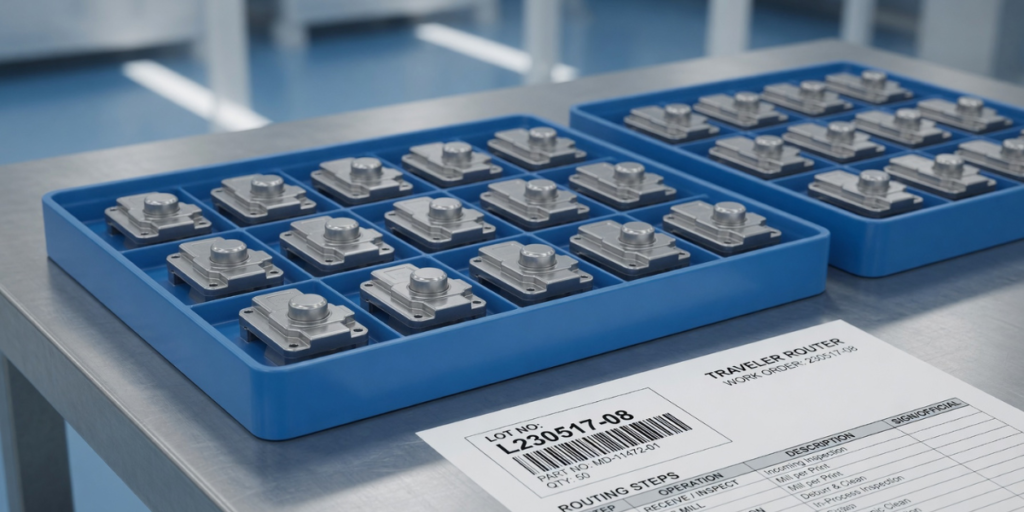
Getting through first article approval is a milestone.
But it is not the finish line.
For medical industry OEMs, the harder question is what happens next.
Can the supplier make the same part again and again? Can they hold tolerance across repeat orders? Can they maintain documentation, traceability, and inspection discipline as volume increases? Can they support the program when demand changes?
That is where medical component production machining gets tested.
A shop may be able to produce a clean first article. But repeat production requires a controlled process, not just a good setup. It takes the right equipment, inspection plan, documentation flow, material controls, and communication habits.
This guide explains how medical device OEMs can reduce risk when moving CNC machined parts from first article approval into repeat production.
First Article Approval Does Not Always Mean Production Readiness
First article inspection proves that a supplier can make the part to print one time.
That matters.
But production readiness is different.
Production readiness means the supplier can repeat the process with control. It means the precision machining strategy, inspection plan, documentation requirements, tooling, and capacity are ready for more than a one-time run.
A medical CNC machining supplier should not treat first article approval as the end of the process. It should be the point where the production process is verified, adjusted, and prepared for repeat orders.
| First Article Approval | Production Readiness |
|---|---|
| Confirms the part can be made to print once | Confirms the process can repeat across batches |
| Focuses on one inspection event | Focuses on ongoing process control |
| Proves the initial setup can work | Proves tooling, workholding, and inspection are stable |
| May support a small launch quantity | Supports repeat releases and higher volume |
| Checks part conformity | Checks supplier capability over time |
| Often tied to engineering approval | Tied to quality, delivery, documentation, and capacity |
The difference matters because many problems do not show up during the first run.
They show up after the part repeats.
Tool wear starts to affect dimensions. Deburring becomes inconsistent. Inspection becomes a bottleneck. Documentation gets missed. A revision change is not communicated clearly. A shop that looked capable during first article starts struggling once the program enters production.
For medical device OEMs, those issues can create delays, quality risk, and extra engineering work.
Where Medical Device Machining Programs Often Break Down After FAI
The move from first article to repeat production can expose weaknesses in the supplier’s process.
A part may pass first article but still be hard to scale.
Common issues include:
- Cycle times that are too long for production quantities
- Fixtures that work for samples but slow down repeat orders
- Tool wear that causes dimensional drift
- Inconsistent edge breaks or deburring
- Surface finish variation
- Inspection plans that are too slow or unclear
- Missing or incomplete material documentation
- Operators relying on tribal knowledge
- Poor revision control
- Limited machine or inspection capacity
- Slow communication when problems appear
These problems do not always mean the part is poorly designed. They often mean the production process was not planned early enough.
That is why production planning should start before the first PO, not after first article approval.
Start Production Planning Before the First PO
A supplier cannot plan for production if they only see a prototype order.
A 10-piece prototype run and a 2,000-piece annual production program may need very different approaches. The best machine, fixture, toolpath, inspection method, and quoting strategy may change once the supplier understands the full production path.
That does not mean the OEM needs every detail finalized. But the supplier should understand the direction of the program.
A strong medical machining RFQ should include more than the print and quantity.
| RFQ Item | Why It Matters for Production Machining |
|---|---|
| 2D drawing | Defines dimensions, tolerances, notes, and inspection requirements |
| 3D CAD model | Helps with programming, fixture planning, and manufacturability review |
| Material specification | Drives tooling, cycle time, traceability, and certification needs |
| Prototype quantity | Helps the supplier plan first article and early development work |
| Expected annual usage | Helps determine whether production fixtures or process improvements are needed |
| Release quantities | Affects machine scheduling, material planning, and lead time |
| Target launch date | Helps the supplier plan capacity and qualification timing |
| Critical-to-quality features | Shows which dimensions or features need extra control |
| Inspection requirements | Prevents gaps in FAI, in-process inspection, and final inspection |
| Documentation requirements | Helps the supplier prepare certs, reports, and traceability records |
| Revision history | Reduces risk of quoting or producing to the wrong print |
| Packaging or handling needs | Protects parts from damage, mix-ups, and contamination risk |
Production expectations should be discussed early, even if the program is still developing.
A supplier may choose one strategy for a small batch and another for repeat production. For example, they may use temporary workholding for first articles but invest in dedicated fixtures for production. They may inspect every feature on early runs but develop a more efficient inspection plan once the process is stable.
When suppliers do not understand the production path, they may quote and process the job in a way that works for early samples but creates problems later.
Why Volume Changes the Machining Strategy
Volume affects almost every part of a CNC machining process.
A supplier making five parts may focus on speed to first article. A supplier making repeat production orders has to think about process control, setup reduction, tooling consistency, inspection efficiency, and delivery reliability.
| Production Factor | Low-Volume / Early Run Approach | Repeat Production Approach |
|---|---|---|
| Workholding | Flexible or temporary setup | Stable fixture strategy |
| Tooling | Standard tools may be acceptable | Tool life and repeatability become more important |
| Programming | Focus on proving the part | Focus on cycle time, consistency, and process control |
| Inspection | Heavy first article focus | Defined in-process and final inspection plan |
| Documentation | May be handled job by job | Must be repeatable and organized |
| Scheduling | One-time order planning | Repeat releases and capacity planning |
| Cost | Driven by setup and learning | Driven by repeatability, cycle time, and yield |
| Risk | Design and print interpretation | Process drift, capacity, and delivery performance |
This is why production machining should not be treated as “more of the same.”
More parts can expose small problems in a big way.
If a feature is hard to deburr, that may be manageable on five parts. It becomes a real issue on 500 parts. If a tolerance requires constant adjustment, that may be acceptable during development. It becomes a risk in production.
A good medical machining supplier looks for these issues before production begins.
Review Manufacturability Before the Part Moves Into Repeat Production
Design for manufacturability is not just an initial step.
It becomes even more important when a part moves into repeat production.
A design feature that is technically possible may still create quality, cost, or delivery risk when repeated across batches. The goal of manufacturability review is not to weaken the design or cut corners. The goal is to protect design intent while making the part easier to machine, inspect, document, and repeat.
Features that can create production risk include:
- Tight tolerance stackups
- Thin walls
- Deep pockets
- Small internal radii
- Hard-to-reach features
- Difficult deburring areas
- Unclear edge-break requirements
- Long thread depths
- Cosmetic requirements that do not affect function
- Features that are difficult to inspect
- Unclear datum structures
- Overly broad surface finish requirements
- Material choices that increase distortion or tool wear
A good supplier should not simply quote the print and move on. They should review the part with production in mind.
That includes asking questions such as:
- Which features are truly critical?
- Which tolerances affect function, fit, or safety?
- Can any tolerances be opened without changing performance?
- Are there features that are difficult to inspect?
- Are there areas that will create deburring risk?
- Is the material appropriate for the application and production volume?
- Will the part remain stable during machining?
- Can the same process support repeat orders?
The earlier these questions are answered, the easier it is to avoid scrap, rework, and production delays.
Lock Down the Machining Process Before Repeat Orders Begin
Repeat production cannot depend on one machinist remembering how the job ran last time.
The process needs to be defined, documented, and repeatable.
That does not mean every part needs the same level of process control. A simple bracket and a complex implantable component are not the same. But for medical device production machining, there should be a clear plan for how the part is made, inspected, documented, and shipped.
A controlled production process should define:
| Process Element | What Should Be Controlled |
|---|---|
| Machine selection | Which machines are approved to run the part |
| CNC program | Revision-controlled program used for production |
| Workholding | Fixture, vise, jaws, clamps, or other setup details |
| Tooling | Tool list, tool life expectations, offsets, and replacement strategy |
| Setup instructions | Clear setup steps that do not rely on memory |
| Critical inspection points | Features checked during setup, in process, and at final inspection |
| Deburring method | How edges, burrs, and sensitive areas are handled |
| Part handling | How parts are protected during and after machining |
| Cleaning or packaging | Any required handling before shipment |
| Documentation | Inspection reports, certs, and production records |
| Revision control | How drawing and process revisions are managed |
This is where experienced suppliers separate themselves from general-purpose job shops.
Medical device production machining requires discipline. The supplier needs to know how to repeat the work without reinventing the process every time an order comes in.
Build Inspection Into the Process, Not Just the Final Step
Quality cannot be inspected in at the end.
For medical device production machining, inspection should be part of the process from the beginning. The inspection plan should match the part, tolerance, risk level, and production volume.
A first article inspection may confirm the first production setup. But repeat orders need a plan for how quality is maintained over time.
Inspection may include:
- First article inspection
- In-process inspection
- CMM inspection
- Final inspection
- Surface finish checks
- Thread verification
- Visual inspection
- SPC data
- Material certification review
- Lot traceability review
The right inspection plan should answer several questions before production starts.
| Inspection Question | Why It Matters |
|---|---|
| Which features are checked during setup? | Confirms the process starts correctly |
| Which features are checked in process? | Helps catch drift before parts are finished |
| Which features are checked at final inspection? | Confirms shipment quality |
| Which dimensions are critical-to-quality? | Focuses control on the highest-risk areas |
| What tools or equipment are used? | Confirms measurements are reliable and appropriate |
| How is inspection data recorded? | Supports documentation and quality records |
| How are nonconforming parts handled? | Prevents escapes and controls corrective action |
| How are drawing revisions managed? | Reduces risk of producing to the wrong revision |
Inspection should not become an afterthought or a bottleneck.
If the inspection plan is unclear, parts may sit after machining while teams try to determine what needs to be checked, how to check it, or what documentation is required.
That delay can be avoided when inspection is planned with production.
Protect Traceability From Material Receipt Through Shipment
Medical device OEMs do not just need parts.
They need proof.
Traceability and documentation are part of the product when CNC machined components are used in regulated or life-critical applications. If a quality issue appears later, the OEM needs to know what was made, when it was made, what material was used, which revision was produced, and what records support the shipment.
Common documentation may include:
| Documentation Type | Purpose |
|---|---|
| Material certifications | Confirms material grade, lot, and source |
| Certificate of conformance | Confirms the parts were produced to stated requirements |
| First article report | Documents first article inspection results |
| Final inspection report | Shows final dimensional results before shipment |
| Process certifications | Supports outside processes when applicable |
| Lot traceability records | Connects shipped parts to material and production records |
| Revision-controlled drawings | Confirms the correct drawing revision was used |
| Nonconformance records | Documents issues and disposition |
| Corrective action records | Shows response to quality problems when needed |
Traceability should answer:
- What material was used?
- Which material lot did it come from?
- What revision was produced?
- Who inspected the parts?
- What inspection equipment was used?
- Were all requirements met before shipment?
- What records support the shipment?
A supplier that cannot manage documentation consistently can create risk even when the parts look correct.
For medical device OEMs, documentation gaps can slow receiving, delay production, create audit problems, or force additional review from quality teams.
That is why documentation needs to be discussed before production begins.
Control Revision Changes Before They Reach the Shop Floor
Revision control is one of the easiest places for production programs to go wrong.
A drawing changes. A model changes. A note gets updated. A tolerance is adjusted. A supplier receives the new revision, but the change is not clearly reviewed before the next production run.
That is how good suppliers can end up making the wrong part.
For medical device production machining, revision changes should be controlled and communicated clearly.
A strong revision process should include:
- Confirming the latest drawing and model
- Reviewing what changed
- Identifying affected features
- Updating CNC programs if needed
- Updating inspection plans if needed
- Updating setup sheets or work instructions
- Confirming documentation requirements
- Communicating any cost or lead time impact
- Preventing old revisions from being used by mistake
Not every revision change is major. But every revision change should be reviewed.
Even a small change can affect tooling, inspection, deburring, cycle time, or documentation.
Plan for Capacity Before Demand Increases
A supplier may support first article and early production but struggle when demand increases.
That creates risk for the OEM, especially after the part is launched and supplier changes become harder.
Before moving into repeat orders, OEMs should ask whether the supplier has the machine capacity, inspection resources, people, and systems to support higher volume.
Capacity questions to ask include:
| Capacity Question | What It Reveals |
|---|---|
| What machines will run the part? | Whether the supplier has a defined production plan |
| Is there backup capacity? | Whether the program is exposed to one machine or one setup |
| Can the supplier support repeat releases? | Whether production can fit into the schedule long term |
| How are lead times managed? | Whether the supplier has planning discipline |
| Can the supplier scale if demand increases? | Whether the supplier can grow with the program |
| Are inspection resources available at higher volume? | Whether quality can keep up with production |
| Is the supplier investing in equipment, people, and systems? | Whether they are preparing for growth |
The risk of outgrowing a supplier is real.
Changing suppliers after launch can create:
- New qualification work
- New first article inspections
- Delayed shipments
- Added engineering workload
- New quality risks
- Higher total cost
- More pressure on purchasing and quality teams
Choosing a supplier that can grow with the program helps reduce this risk.
For medical device OEMs, supplier stability is not just convenient. It protects the production plan.
Keep Communication Tight as Orders Repeat
Production machining requires more than making chips.
It requires clear communication between the OEM and supplier, especially when forecasts shift, schedules change, or engineering revisions are released.
Good supplier communication includes:
- Clear order status
- Early notice of risks
- Fast response to engineering questions
- Review of revision changes
- Documentation follow-up
- Open discussion about capacity
- Support for future production planning
Poor communication can cause:
- Wrong revision production
- Missed delivery dates
- Incorrect documentation
- Unclear inspection requirements
- Rework
- Scrap
- Line-down risk
The best suppliers surface issues early.
They do not wait until the due date to explain a problem. They communicate when a material issue appears, when an inspection requirement is unclear, when a forecast may exceed capacity, or when a design feature could create production risk.
For medical device production machining, that kind of communication helps protect both quality and delivery.
Prototype Machining vs. Production Machining for Medical Devices
Prototype machining and production machining are related, but they are not the same.
A supplier that is good at prototypes may not be ready for repeat production. A supplier that is good at production may approach the job differently from the beginning.
| Area | Prototype Machining | Production Machining |
|---|---|---|
| Main goal | Prove the design | Repeat the process |
| Quantity | Low | Repeat or higher volume |
| Process | Flexible | Controlled |
| Documentation | May be limited | Required and repeatable |
| Inspection | Part-specific | Process-driven |
| Cost focus | Speed and learning | Repeatability and efficiency |
| Supplier need | Fast turnaround | Quality, capacity, and consistency |
| Workholding | Often flexible | Stable and repeatable |
| Communication | Engineering-heavy | Engineering, quality, purchasing, and production |
| Risk | Design uncertainty | Process drift, documentation, and delivery |
Many medical device programs need both capabilities at different points.
Early in the process, speed and engineering feedback matter. As the program moves toward production, repeatability, inspection, and documentation become more important.
The right supplier understands both stages and helps bridge the gap.
What to Look for in a Medical Device Production Machining Supplier
The right supplier should be able to support both the part and the program.
That means they need more than CNC machines. They need a quality system, inspection discipline, documentation control, communication habits, and enough capacity to support repeat orders.
Look for a supplier with:
- ISO 13485 certification
- Experience machining medical device components
- Strong inspection capability
- Material traceability controls
- First article inspection experience
- Clear documentation processes
- Capacity for repeat production
- Engineering and manufacturability support
- Strong communication
- Experience serving regulated industries
A good supplier should also be willing to talk through risk before the order is placed.
They should ask questions about volume, inspection, tolerances, material, documentation, and delivery expectations. If a supplier only says “send the print” and never discusses the production path, that may be a warning sign.
Supplier Evaluation Checklist for Medical Device Production Machining
Use this checklist when comparing CNC machining suppliers for medical device production work.
| Supplier Requirement | Why It Matters | Question to Ask |
|---|---|---|
| ISO 13485 certification | Shows the supplier has a quality system aligned with medical device manufacturing | Are you ISO 13485 certified? |
| First article experience | Supports qualification and production launch | Can you provide FAI documentation? |
| CMM inspection capability | Helps verify tight-tolerance features | What inspection equipment will be used? |
| Material traceability | Supports regulated and quality-critical applications | How do you maintain material lot traceability? |
| Revision control | Reduces risk of producing outdated parts | How do you handle drawing and model revisions? |
| Production capacity | Protects future delivery performance | Can you support repeat releases and higher demand? |
| Engineering support | Helps reduce manufacturability risk | Do you review parts for DFM before production? |
| Documentation discipline | Supports receiving, quality, and audits | What documentation can be provided with shipment? |
| Communication process | Reduces surprises | How do you communicate risk, delays, or changes? |
This kind of evaluation helps move the decision beyond price.
Price matters. But the lowest part price can become expensive if the supplier creates delays, documentation issues, quality escapes, or repeat qualification work.
Common Mistakes When Scaling Medical CNC Machined Parts
Scaling from first article to repeat production is easier when OEMs avoid a few common mistakes.
Choosing a Supplier Based Only on Prototype Speed
A fast prototype supplier may not be set up for repeat production.
Prototype work often rewards speed and flexibility. Production work rewards repeatability, documentation, inspection planning, and capacity.
Before moving a part into repeat production, make sure the supplier can support the long-term needs of the program.
Waiting Too Long to Discuss Volume
Volume changes the machining strategy.
If the supplier does not know the expected annual usage, they may choose a process that works for samples but does not scale. Sharing forecast expectations early helps the supplier plan tooling, fixtures, inspection, and capacity.
Treating Inspection as a Final Step
Inspection should be built into the process from the start.
If inspection is only discussed after the parts are machined, there may be delays, measurement issues, or documentation gaps.
The inspection plan should be clear before production begins.
Not Reviewing Documentation Requirements Upfront
Documentation gaps can delay shipments and create quality issues.
Medical device OEMs should confirm documentation requirements before the job is quoted and before the first production run. This includes material certs, inspection reports, certificates of conformance, and any customer-specific requirements.
Ignoring Supplier Capacity
A supplier without room to grow can become a bottleneck when demand increases.
Capacity should be part of the sourcing decision, especially for parts that are expected to move from first article into repeat orders.
Assuming First Article Approval Means the Process Is Stable
First article approval is important, but it does not automatically prove long-term process stability.
The supplier still needs to control tooling, workholding, inspection, revision changes, documentation, and production scheduling.
Final Thoughts: Production Machining Is About Repeatable Confidence
Medical device OEMs do not just need a supplier that can make a part once. They need a supplier that can make the part consistently, document the process, communicate clearly, and support the program as it grows.
That is the real test of medical device production machining. First article approval proves the part can be made. Repeat production proves the supplier can support the program.
The right production machining partner helps reduce risk from first article through repeat orders.