
Table of Contents
- Introduction
- Key Takeaways
- Certifications & Quality Systems Every Aerospace Machine Shop Needs in 2026
- What Materials Are Used in Aerospace CNC Machining?
- Advanced CNC Machining Processes That Give Aerospace Companies a Real Advantage
- Flight-Critical vs. Non-Critical Aerospace Parts: How Risk Drives Precision Machined Components
- Aerospace and Space: Applications of CNC Machining Across the Aerospace Sector
- Considerations in Aerospace CNC Machining: Overcoming the Real Challenges
- How to Choose an Aerospace Machine Shop for Precision CNC Machining Services
- Real-World Applications of CNC Machining in Aerospace
- From Prototype to Full-Rate Production: Scaling Aerospace Machining Services
- Supply Chain Risk Mitigation for Aerospace Manufacturing
- The Future of Aerospace CNC Machining: 2026 Trends Leading Aerospace Companies Are Planning For
- Design for Manufacturability: Why Precision Matters in Aerospace CNC Machining
- Aerospace CNC Machining FAQ
Introduction
Commercial aerospace is in the middle of one of its strongest production stretches in years. The global aerospace parts manufacturing market is on pace to hit roughly $1.04 trillion in 2026, growing at a CAGR of about 5.4% as airlines work through record aircraft order backlogs and fleet renewal cycles. IATA projects global passenger traffic will reach a record 5.2 billion travelers in 2026 alone.
At the same time, commercial space has moved from experimental to industrial: the global space economy is running near $626 billion, and 2025 closed out with 329 orbital launch attempts worldwide, an all-time record.
Both sectors are pulling on the same supply base of precision CNC machine shops, and both are running into the same bottleneck across the aerospace industry: not enough qualified, capacity-ready shops with the CNC machines and capacity to keep up with build rates.
Some of this work overlaps with defense programs. A structural bracket or a fastener spec’d for a commercial airframe can end up on a military variant of the same platform, and some space work touches national security payloads. That overlap is real, but it’s not the focus of this guide.
This guide is about what the commercial aerospace industry and space OEMs need from a CNC partner today: certifications that matter, materials and finishes experienced buyers actually specify, how to vet a shop, and where aerospace and space requirements are alike and where they’re not. The fundamentals below apply whether you’re sourcing a single prototype run or qualifying a long-term production partner.
At OCD (Olson Custom Designs), we’ve built our CNC machine shop around this exact work. We’re AS9100D and ISO 9001:2015 certified, GE S1000 approved, and we’ve spent over a decade delivering machining services that move from prototype to full-rate production for aerospace and space customers who can’t afford a supplier that doesn’t scale.
Key Takeaways
- AS9100D is the floor, not the ceiling. OEM-specific supplier quality specs (like GE S1000) often matter more in practice than the base certificate.
- Material choice drives everything downstream: tolerance, finish, tooling strategy, and cost. Aluminum, titanium, superalloys, and precipitation-hardened stainless each carry different machining realities.
- Flight-critical parts require a different quality system than ground-support hardware: not just tighter tolerances, but different documentation, inspection frequency, and traceability.
- Aerospace and space share a materials and tolerance baseline, but space adds extreme-environment requirements and compressed qualification timelines that traditional aerospace suppliers aren’t always built for.
- Vetting a shop on certifications alone isn’t enough. On-time delivery history, DFM collaboration, and capacity to scale matter just as much.
Certifications & Quality Systems Every Aerospace Machine Shop Needs in 2026
Certification gets a supplier through the door. It doesn’t guarantee they can execute. Here’s what experienced procurement and quality teams actually look for.
AS9100D is the baseline quality management standard for aerospace manufacturing and effectively the price of entry into the aerospace industry’s supply chain, built on top of ISO 9001 with additional requirements specific to aviation, space, and defense supply chains: risk management, configuration management, first-article inspection, and counterfeit-parts prevention among them. A shop without it generally can’t get on an aerospace OEM’s approved supplier list at all.
OEM-specific supplier quality specs are where things get more selective. Companies like GE Aerospace maintain their own supplier requirements (GE S1000 being one example) layered on top of AS9100D, covering things like specific process controls, source inspection requirements, and documentation formats unique to that OEM’s supply chain. A shop holding AS9100D but not the OEM-specific approval may still need to go through a separate qualification process before it can quote certain programs.
A note on defense crossover: some aerospace components (especially airframe and engine parts shared across military variants) carry ITAR registration or other defense-specific requirements. If your program has that overlap, ask your supplier directly about their ITAR status rather than assuming AS9100D covers it. It doesn’t.
| Certification/Requirement | What It Covers | Why OEMs Prioritize It | What to Request in Audits |
|---|---|---|---|
| AS9100D | Risk management, configuration control, FAI, counterfeit-parts prevention | Baseline qualification for aerospace supply chains | Current certificate + recent audit summary |
| ISO 9001:2015 | General quality management system | Foundation AS9100D builds on | Certificate + scope of registration |
| OEM-specific specs (e.g., GE S1000) | Prime-specific process controls, documentation, source inspection | Required for many program-specific awards | Evidence of active OEM approval/qualification |
| Material & process traceability | Lot-to-part traceability, certs of conformance | Required for recalls, root-cause investigations, audits | Sample traceability package on a comparable part |
What Materials Are Used in Aerospace CNC Machining?
Material selection in this world is rarely just about strength. It’s a balance of strength-to-weight ratio, thermal behavior, corrosion resistance, and machinability, and the right answer changes depending on whether a part flies in the atmosphere or beyond it.
- Aluminum (7075, 6061, 2024): The workhorse of airframe and structural components. Excellent strength-to-weight ratio, good machinability, and a long track record in both commercial aircraft and satellite structures.
- Titanium (Ti-6Al-4V): Used where high strength, high heat resistance, and low weight all matter at once: engine components, structural fittings, and increasingly in space applications where thermal cycling is severe. Titanium is hard on CNC machines: it cuts slowly and generates heat fast, so tooling strategy and coolant management matter more here than almost anywhere else in the shop.
- Superalloys (Inconel, Hastelloy): Reserved for the harshest thermal environments: turbine sections, exhaust components, and propulsion hardware. Extremely difficult to machine; tool wear and cycle time both climb sharply compared to aluminum or steel.
- Precipitation-hardened stainless (17-4, 15-5): Common in fasteners, brackets, and mechanisms where strength and corrosion resistance matter more than extreme weight savings.
Finishing matters just as much as base material selection. Anodizing (Type II or Type III/hard coat) is standard on aluminum structural parts for corrosion resistance and wear, while passivation is standard on stainless components to remove free iron and stabilize the surface oxide layer.
Specialty thermal barrier coatings show up on hot-section components where the base material alone can’t survive sustained exposure.
| Material | Spec/Grade | Primary Strengths | Typical Application | Machining Notes |
|---|---|---|---|---|
| Aluminum 7075-T6 | AMS-QQ-A-250/12 | High strength-to-weight | Structural brackets, airframe components | Good machinability; standard tooling |
| Aluminum 6061-T6 | AMS-QQ-A-250/11 | Good machinability, corrosion resistance | General structural, satellite panels | Easy to machine; widely available |
| Titanium Ti-6Al-4V | AMS 4911 | High strength, heat resistance, low weight | Engine mounts, structural fittings, satellite structures | High tool wear; requires rigid setups, controlled feeds/speeds |
| Inconel 718 | AMS 5662/5663 | Extreme heat and corrosion resistance | Turbine components, exhaust systems | Very difficult to machine; specialized tooling required |
| Stainless 17-4 PH | AMS 5643 | High strength, corrosion resistance | Fasteners, brackets, mechanisms | Moderate machinability; passivation standard |
Advanced CNC Machining Processes That Give Aerospace Companies a Real Advantage
Basic 3-axis CNC machines still have a place in this industry, but the parts that separate a capable shop from a marginal one increasingly demand more advanced CNC equipment built for complex geometries.
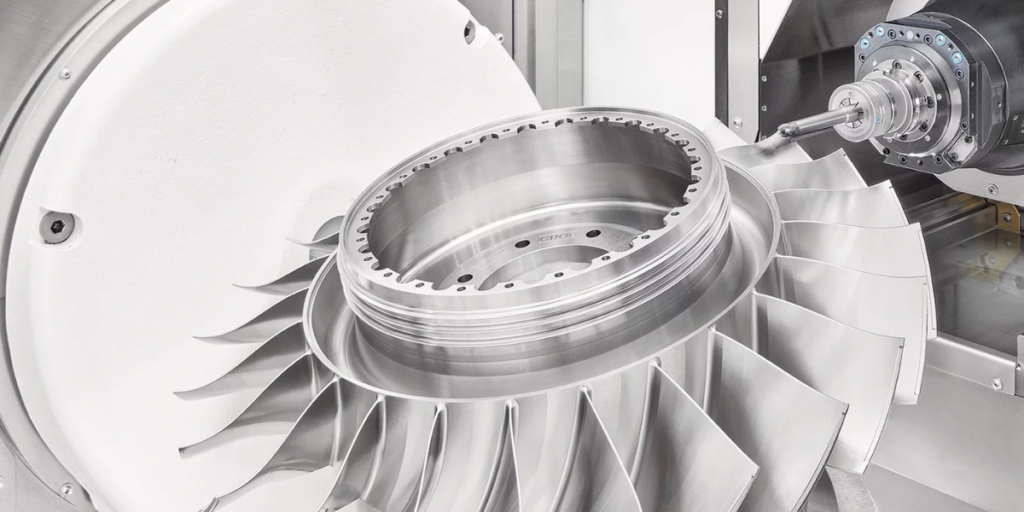
- 5-axis milling with pallet-pool automation: Enables single-setup machining of complex structural and turbine geometries, cutting the tolerance stack-up that comes from repositioning a part across multiple setups. Automation supports consistent output on longer production runs without sacrificing precision.
- Live-tooling turning and mill-turn: Combines turning and milling operations in a single machine, ideal for small precision components (fittings, connectors, and hardware) where repositioning risks introducing error.
- Swiss machining: Well suited to small-diameter, high-precision components common in avionics and instrumentation hardware.
- Hard turning: Machining hardened materials directly rather than machining soft and heat-treating after, which can reduce distortion risk on close-tolerance parts.
- EDM (electrical discharge machining): Used for features that are difficult or impossible to reach with conventional cutting tools: deep slots, complex internal geometries, and hardened materials.
- In-process metrology: CMM and vision-based inspection integrated into the production flow catch deviations before a part reaches final inspection, which matters most on flight-critical features with no tolerance for rework.
Flight-Critical vs. Non-Critical Aerospace Parts: How Risk Drives Precision Machined Components
Not every aerospace part carries the same consequence if it fails. A structural bracket that fails in flight is a different problem than a ground support fixture that fails in a hangar, and the machining, documentation, and inspection requirements scale accordingly.
The distinction matters when you’re choosing a supplier: a shop with strong non-critical-part experience doesn’t automatically have the documentation discipline flight-critical work demands.
| Aspect | Flight-Critical (e.g., structural brackets, engine components, satellite structures) | Non-Critical (e.g., ground support equipment, tooling fixtures) |
|---|---|---|
| Tolerances | Tight, often ±0.0005″ or tighter on critical features | Standard commercial tolerances, ±0.005″ typical |
| Materials | Aerospace-grade alloys with full material certifications | Broader material flexibility |
| Documentation | Full FAI, material traceability, process validation records | Standard inspection records |
| Inspection | 100% inspection on critical features, CMM verification | Sampling plans generally sufficient |
| Regulatory Weight | Heavier scrutiny; tied to airworthiness or mission success | Lower scrutiny |
Aerospace and Space: Applications of CNC Machining Across the Aerospace Sector
Aerospace and space manufacturing draw from the same materials list and the same tolerance mindset, which is why a lot of qualified aerospace shops naturally end up doing space work too. But the two aren’t identical, and treating them as interchangeable is a mistake.
What’s shared: tight tolerances, full material traceability, AS9100D as the baseline quality system, and machinists who are used to being told a part has zero margin for a bad day.
Where space diverges:
- Extreme-environment performance. Space hardware has to survive vacuum, radiation exposure, and thermal cycling that swings hundreds of degrees between sun and shadow. Atmospheric aerospace components never see conditions like these, which changes material selection and sometimes finishing requirements even when the part geometry looks similar to an aerospace counterpart.
- Compressed qualification timelines. Commercial space companies, especially newer launch and satellite manufacturers, often move at a pace closer to a startup than a legacy aerospace prime. They need a supplier that can turn a first article fast without cutting corners on documentation.
- Small-batch, iterative production. Where traditional aerospace programs often stabilize into long, predictable production runs, space programs (particularly satellite constellations in active development) may need several design iterations machined in short order before locking a final configuration.
Some programs blend commercial and defense requirements even within the space sector. When that comes up, it’s worth a direct conversation with your supplier about what’s actually required for that specific contract rather than assuming standard commercial terms apply.
Considerations in Aerospace CNC Machining: Overcoming the Real Challenges
Even well-equipped shops run into recurring friction points on this kind of work.
- Machining superalloys and titanium without excessive tool wear or scrap. High heat buildup during machining causes tool wear and can compromise surface integrity on parts where finish affects fatigue life. The fix is a combination of sharp carbide or ceramic tooling, controlled feeds and speeds, and rigid setups that minimize vibration.
- Holding tolerance across long production runs. CNC machines drift, tools wear, and small variances compound over a multi-year program. Statistical process control and in-process metrology catch drift before it becomes a nonconformance.
- Legacy part reproduction. Older aircraft platforms and some satellite bus designs still fly with components that predate current CAD standards, sometimes with drawings that need to be reverse-engineered before a part can be quoted. This takes engineering time most shops don’t budget for up front.
- Reconciling space’s rapid iteration with aerospace’s qualification rigor. A shop set up to serve traditional aerospace primes on long, stable production runs isn’t always structured to turn around three design revisions of a satellite bracket in a month while still delivering full documentation on each one.
How to Choose an Aerospace Machine Shop for Precision CNC Machining Services
Certifications narrow the field. These are the questions that actually separate a reliable long-term partner from a supplier that looks good on paper.
Checklist:
- Certifications that match your program: AS9100D at minimum, plus any OEM-specific approvals your primes require.
- Demonstrated capacity: ask for CNC machine lists and current utilization, not just a capabilities brochure.
- Material traceability: request a sample traceability package on a comparable part before you commit.
- References across both aerospace and space programs if your work spans both. A shop that’s only done long-run commercial aerospace components may not be ready for a fast-turn satellite program.
- DFM collaboration: how quickly and how substantively do they engage on design for manufacturability during quoting?
- Responsiveness: a fast, specific RFQ turnaround is often the clearest early signal of how a shop will behave once you’re a customer.
Red flags:
- Offshore sourcing for critical materials without clear traceability
- Thin or vague quality documentation
- No OEM-specific approvals when your program requires them
- Slow or generic responses to technical questions during quoting
Real-World Applications of CNC Machining in Aerospace
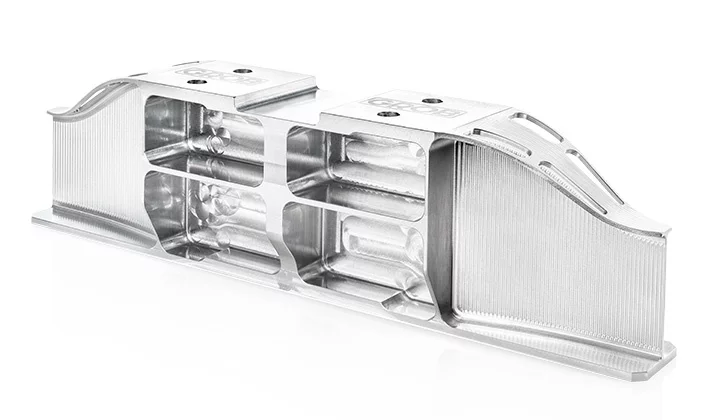
CNC machining supports a wide range of aerospace applications and space hardware, including:
Aerospace: structural brackets, engine mounts and components, avionics housings, landing gear components, actuator housings.
Space: satellite structural panels and brackets, launch vehicle components, payload adapters, ground support equipment for integration and test.
From Prototype to Full-Rate Production: Scaling Aerospace Machining Services
Moving from a handful of prototype parts to sustained production volume is where a lot of otherwise-good suppliers stumble. A structured approach protects both quality and schedule:
- First article and design freeze: Full first-article inspection, material certifications, and a DFM review before locking the design for production.
- Process qualification: Validate machining parameters across multiple runs; establish process capability (CpK) on critical dimensions.
- Automation integration: Pallet-pool systems and lights-out machining across CNC machines reduce operator variability as volume scales.
- Staged quality gates: Prototype → pilot → full-rate production, each with updated documentation and inspection records.
- Volume ramp planning: Forecast material lead times and machine capacity ahead of the ramp, not during it.
- Ongoing monitoring: Trend analysis on inspection data supports continuous improvement and catches drift before it becomes a nonconformance.
Supply Chain Risk Mitigation for Aerospace Manufacturing
Supply chain resilience has become a real competitive factor in both commercial aerospace and space procurement. Material shortages, tariff exposure, and long offshore lead times have pushed OEMs toward domestic sourcing wherever possible.
Domestic suppliers offer a few concrete advantages: shorter and more predictable lead times, easier in-person audits and quality oversight, faster design-change turnaround, and (particularly relevant for fast-moving space programs) the ability to respond same-week to a design iteration instead of waiting on an overseas shop’s queue.
At OCD, our Indiana location puts us within easy reach of major aerospace and space customers across the Midwest, with the domestic supply chain stability and responsiveness both sectors are increasingly prioritizing.
The Future of Aerospace CNC Machining: 2026 Trends Leading Aerospace Companies Are Planning For
- AI-assisted inspection. Vision-based systems are catching micro-defects on flight-critical features that human inspection can miss, while cutting inspection time.
- Hybrid additive + CNC workflows. Near-net-shape additive manufacturing followed by CNC finishing is gaining traction for lightweight structural components and legacy part reproduction where tooling for traditional subtractive-only manufacturing no longer exists.
- Commercial space growth reshaping supplier expectations. With 329 orbital launch attempts in 2025 and mega-constellation programs sustaining high launch cadence, more OEMs are seeking suppliers who can match space’s iteration speed without sacrificing the documentation rigor aerospace customers expect.
- Predictive maintenance for CNC equipment. Sensor-driven monitoring is helping shops catch machine issues before they cause scrap or downtime, increasingly important as programs run CNC machines around the clock to hit cadence.
Design for Manufacturability: Why Precision Matters in Aerospace CNC Machining
Early DFM input can meaningfully reduce cost and lead time without compromising airworthiness or mission requirements.
- Minimize setups. Design parts to be machined in as few orientations as possible: every additional setup adds cost and introduces another opportunity for tolerance stack-up.
- Avoid unnecessarily deep pockets or thin walls. Features deeper than 4–5x the tool diameter increase deflection risk and cycle time.
- Standardize radii. Consistent internal radii that match standard tooling avoid the cost of custom cutters or EDM.
- Apply tight tolerances only where they matter. Reserve the tightest tolerances for features that actually require them; loosen non-functional dimensions to cut inspection burden.
- Choose machinable features early. Avoid undercuts or complex contours that require full 5-axis machining unless the application genuinely demands it.
- Loop in your supplier during design, not after. The earlier a shop sees a drawing, the more cost and schedule savings they can usually find.
Aerospace CNC Machining FAQ
What’s the difference between AS9100 and ISO 9001? AS9100D is built on ISO 9001 with added requirements specific to aerospace: risk management, configuration control, first-article inspection, and counterfeit-parts prevention. ISO 9001 alone doesn’t cover these; most aerospace OEMs require AS9100D specifically, not just ISO 9001.
What tolerances are typical for aerospace machined parts? It depends on the part’s criticality. Flight-critical features often hold tolerances of ±0.0005″ or tighter, while non-critical structural or ground-support components may run standard commercial tolerances around ±0.005″. The application, not a blanket industry standard, determines the requirement.
How is machining for space components different from aerospace? Space hardware has to survive vacuum, radiation, and extreme thermal cycling that aerospace parts never encounter, which can affect material and finish choices. Space programs, especially newer commercial ones, also tend to move on faster, more iterative timelines than traditional aerospace production runs.
What is a flight-critical component? A flight-critical component is one whose failure could affect airworthiness or mission success, such as structural brackets, engine components, and certain avionics housings. These parts carry tighter tolerances, more extensive documentation, and higher inspection frequency than non-critical hardware.
How long does it take to qualify a new aerospace supplier? It varies by OEM and program complexity, but qualification typically involves certification verification, a facility audit, first-article inspection on a representative part, and sometimes an OEM-specific approval process on top of AS9100D. Building in lead time for this step early avoids schedule surprises later.
What’s the difference between prototype and production aerospace machining? Prototype machining prioritizes speed and design validation, often with less process documentation. Production machining requires validated, repeatable processes, statistical process control, and full traceability. The transition between the two is where many suppliers struggle to maintain quality at scale.
Does OCD work with commercial space companies? Yes. OCD supports both traditional aerospace production and commercial space programs, including the faster iteration cycles and compressed timelines common among newer space companies.
How do I choose a CNC machine shop for aerospace components? Start with certifications that match your program (AS9100D at minimum, plus any OEM-specific approvals), then verify capacity, material traceability practices, and DFM responsiveness. References from comparable programs, and how quickly a shop turns around a detailed RFQ, are often the clearest signals of how they’ll perform as a long-term partner.
Why does 5-axis machining matter for aerospace applications? 5-axis machining allows complex geometries to be cut in a single setup instead of multiple repositions, which reduces tolerance stack-up, improves surface finish on contoured features, and shortens cycle time. All of this matters on flight-critical components with little margin for error.